
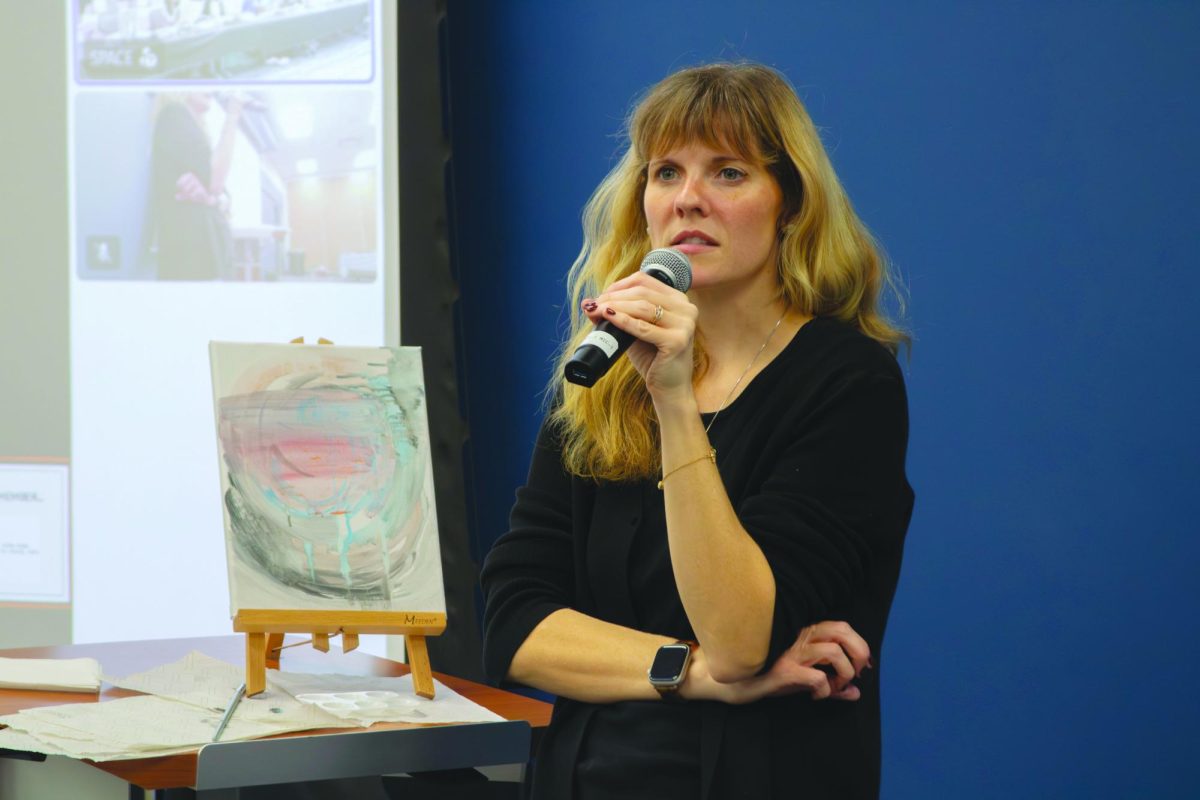
Many people consider therapy to be talking with a professional or looking at ink blots. However, Aubrey Webster, a member of Dallas College’s Counseling and Psychological Services (CAPS) takes a different approach. She is the only licensed art therapy counselor in Dallas College.
Webster calls art therapy “a type of mental health counseling that uses all types of materials, with visual art materials to help express and process emotions and past events that folks have been through.” As such, it is focused on using art to communicate with the students she works with.
According to Webster the goal is not to create masterpieces. Instead, she considers art therapy to be an opportunity to explore students’ emotions. “Art Therapy is process versus product. A lot of times we get pulled out of processing our emotions. A lot of art therapy art is not very, like, aesthetically beautiful, the pieces. It’s just it’s a lot of emotions and it’s a lot focusing on the process of making art and not so much the finished product,” she said, adding that the process allows students to reflect on their emotions in a constructive way.
Art Therapy has been practiced for over 80 years, with the two notable figures in its founding being women. Webster said “The first kind of art therapists were around in the 1940s. Two American art therapists were Edith Kramer and Margaret Naumburg. They kind of represent two trajectories of art therapy.” She said these two trajectories were the use of art to improve the quality of therapy and the process of creating art as the therapy itself.
“Edith was a teacher and she worked with a lot of children. She used art as therapy, so she comes from background and the understanding anytime you make art, you’re expressing your feelings and you’re moving things, you’re and you’re able to process events,” Webster also said that Kramer focused on art as a way for people to explore their memories and emotions in a safe and accessible way, without the need for external communication.
Webster said Margaret Naumburg was also instrumental in the evolution of art therapy. ”She’s from the Freudian and the psychology side and so she really feels how art can tell us a deeper story and help us connect more with our clients in a mental health space.” She said that Naumburg focused on using the art creation process as a way for clients to visualize their thoughts, prompting her clients to analyze the artwork to explore their feelings. These two processes of art therapy help form art therapy as it is today.
While professional counselors such as Webster practice art therapy, she said these techniques can also provide a self-help outlet. “You don’t really need a therapist, you can just do art.”
Shannon West, an adjunct instructor at Richland campus, views the process of creating art as a conversation between the viewer and the artist, without any words being spoken. “Art is a very direct way of expressing ourselves, especially in terms of, we call it a picture of it’s worth a thousand words for a reason.”
West sees the process of art therapy as a way for students to create works of art that speak to people in different ways. “Some students see it as a way for them to create something beautiful and see art as something that can be used to create something beautiful, something that is pleasing with the people,” she said.
However, West also sees art as a way for students to communicate, whether that be through pleasant images or disturbing scenes. “It can be something that is grotesque, gritty or upsetting in the same way that the conversations that we have are also…can also be gritty, grotesque and upsetting in many ways, but what’s important is that it is being used as an expression” west said.
Webster said art therapy is very client-specific. “We have set interventions, just like all therapies do. Types of work that we can do together to help process feelings, but really, the treatment plan is very individualized.” She said she adjusts her work depending on the needs of the person she is working with, and like many therapists, can use her expertise to help students navigate their emotions.
“I view it as a way to help process emotions and help people manage and express their feelings, whether you’re a professional artist or you’ve never done art before. I think people are naturally artistic and expressive,” Webster said.
Caleb Giddings, an Art Major student at Richland Campus, shares this sentiment, seeing art as a way for people to communicate regardless of skill level. “I feel like it gives them a good chance to really just get out some emotions or even just calm themselves down,” he said.
Read the full story at richlandstudentmedia.com