
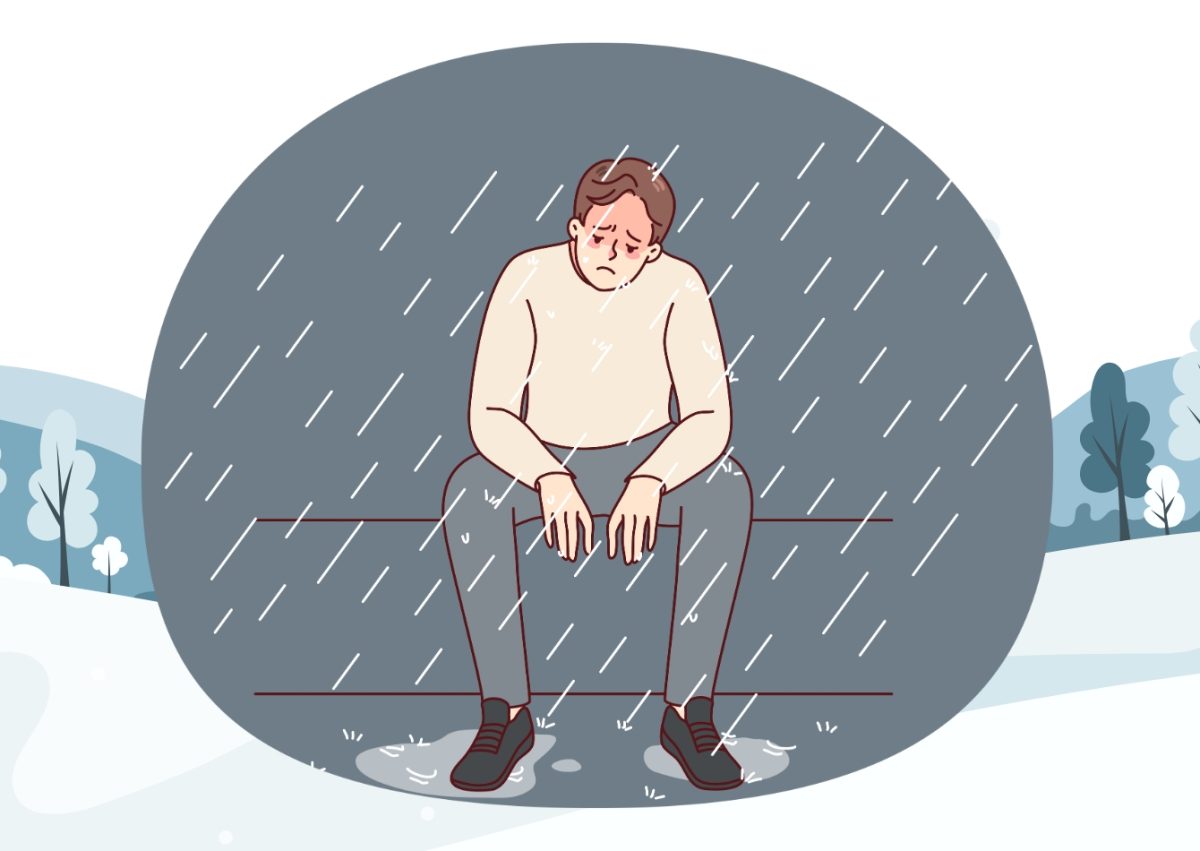
Winter arrives every year, and yet it always has a way of catching people off guard.
What’s meant to feel festive and cozy sometimes feels like someone pressed the dim button on life without asking. For many Richland Campus students, the holiday season doesn’t consist of peppermint lattes or final exams, but rather of a quiet battle with their own minds.
Students describe the colder months not as sad or catastrophic but as slower.
Homework still gets done but enthusiasm doesn’t always match output.
It takes more effort to move through a day that ends so early.
For some, the change is just a mental fog that rolls in.
“Around winter, I feel like I’m running out of time every day and just overall not as happy because it gets so dark super early,” said Saela Phuyet, a Richland business student. “I still finish everything, but it takes more effort, I think. Like, I just feel drained every day.”
She said she notices this difference every year when the days shorten. She wakes up on time, but more slowly. She studies, but with extra effort.
Other students describe the seasonal slowdown in sharper terms. The most common pattern they mention is not sadness but drag where days feel longer and motivation thins even when responsibilities stay the same. Carlos Munoz, a Richland criminal justice major diagnosed with Seasonal Affective Disorder (SAD), said he has learned to see the shift coming before it peaks.“As a person who’s had it for so long, you start noticing the signs,” he said. “I start feeling sluggish. I start sleeping more.” If he doesn’t intervene early, the season compounds. School, work, routine, all of it stacks. “Usually, it’s just like a sense of burnout. And then on top of that, then with school, plus work … you’re just sitting there like, what am I doing? Why am I here? What’s the point?”
Munoz notes that male stigma makes expression difficult. “It’s still that sense of, like, suffering in silence,” he said. “Why am I gonna go talk to somebody else? Everyone has a problem.”
Instead, he interrupts the crawl with habits: getting sunlight when he can, radio shows, music, comfort foods.
Across interviews and observations, one theme repeats: The season doesn’t break students, but it bends their pace. They manage that shift by negotiating with it and ultimately pushing through it.
The seasonal slowdown also shows something significant about student life: Productivity is not always tied to excitement. Sometimes students work without spark, purely through discipline. Sometimes they rest more, not necessarily because they want to or afford to, but because their bodies demand it.
As the semester continues, energy slowly gets reintroduced when signs of spring creep in. The area near the lake outside Fannin Hall fills with students again, and outdoor tables reclaim study groups.
But winter will forever remain a part of the academic cycle. Some fight it, some accept it and some reshape their habits to move through it more smoothly. It is simply another variable in student life, like workload or weather.
The light returns eventually, but until then, life will have to run on intention.
And students seem to understand that better than anyone.