Holocaust survivor Hanna Schrob spoke to Richland students about her experience as a Jew in Nazi-controlled Europe at a roundtable event in Red River Hall on Nov. 17.
The event was organized as part of an initiative by Phi Theta Kappa titled the Honors In Action project. According to PTK president Jesus Gonzalez, the initiative was created to explore how different media used in storytelling can shape stereotypes on marginalized groups.
“More than anything, we wanted people to learn to be able to tell their own story without relying on journalists or movies to cover them,” said Gonzalez.
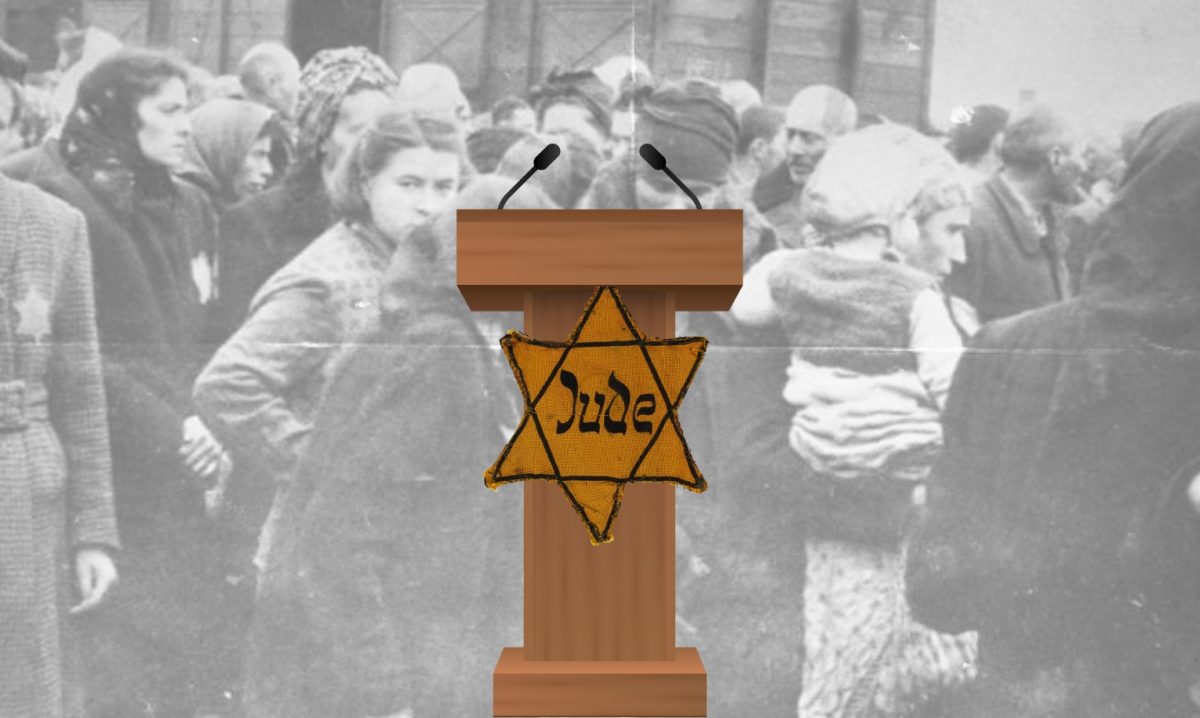
Schrob was born in 1936 in Maastricht, Holland to German American parents who migrated from Germany after experiencing a growing culture of discrimination against Jews. In 1940, Hitler conquered Holland, and Jewish people lost their ability to own businesses, attend schools, drive cars, or even own telephones. Schrob spoke about not being allowed to walk outside without having the Star of David visible on her clothes to signify she was a Jew.
She also spoke about how, during this time, she watched her mother give birth to her fourth child in the middle of an air raid with no medical assistance.
As conditions got dramatically worse, Schrob’s family tried unsuccessfully to leave for America many times. Eventually, after their town’s mayor reported them to the Nazis, Schrob’s family was taken by the Gestapo and placed in Westerbork, a transit camp that temporarily held Jews to be deported to death camps in Eastern Europe.
“Each time we were scheduled for transport to a death camp, the trains were so full that we could not board. We were told to return to our vats and wait for the next transport,” said Schrob.
However, Schrob and her family were ultimately saved from being sent to a death camp and instead were transferred to Liebenau, an internment camp in Germany. Due to him being a German national, Schrob’s father was separated from the rest of the family and taken away to a different camp.
“As we left my father behind,” Schrob said, “I recall my mother saying that most likely we will never see him again.”
In the internment camp, conditions were harsh. Schrob recalled sleeping on bunk beds that were bare wood, with no mattress or padding provided. Due to limited food, her mother could no longer nurse her baby, and her survival became questionable. Schrob said that she would have to sleep on her newborn sister’s wet diapers in order to dry them out and keep reusing them.
From Liebenau, Schrob and her family were taken to Vittel, a camp in France. At Vittel, many Jews were taken away daily to be murdered at the Polish death camp of Auschwitz. Schrob spoke about one of her most terrifying memories where, as she was running to a bunker with her sister’s beat-up carriage as bombs were dropped above her head, the carriage tipped over and her sister rolled out to the street. Schrob quickly picked her up and ran to the bunker as fast as she could.
“Without a second to spare, we reached the door and they pulled us in just as they were locking the doors,” said Schrob. “I can still see the whole thing as it happened yesterday.”
In September 1944, Vittel was liberated by American soldiers, and Schrob met her father after not having seen him for two years. Schrob and her family were housed in a hotel in France to orient themselves to life as free people before getting passage on a ship to America. They arrived in Boston, and Schrob described being served doughnuts and hot chocolate by the American Red Cross.
“They were so good, and I still have a great fondness for doughnuts.”
Schrob and her family moved to Orange, New Jersey, where they learned to speak English and had to adjust to life in the United States.
“I had to learn that when a plane flew over my house, I no longer had to crawl under the bed,” said Schrob. “It took quite a while to get over that fear.”
Schrob attended school, got married and had four children.
She returned to Holland with three of her children to the city of Breda, where she and her husband rebuilt a synagogue that was destroyed during the war. Schrob said this was one of the highlights of her life.
She concluded her session by speaking about antisemitism.
“Over the years, I have experienced antisemitism, but many times not to the extent that it is happening in America today,” said Schrob.
“It is so sad that we have to fear going to the synagogue to worship and to endure hatred and violence all over again.”
Schrob also emphasized the importance of learning about history.
“If you don’t understand antisemitism in the past, how can you possibly understand that people are using it the exact same way today?”
Schrob’s visit to Richland was coordinated through the Dallas Holocaust and Human Rights Museum.
It is the first of five total sessions being hosted by PTK as part of the Honors In Action project, which includes a field trip to the Holocaust and Human Rights Museum.
For more information, contact [email protected].