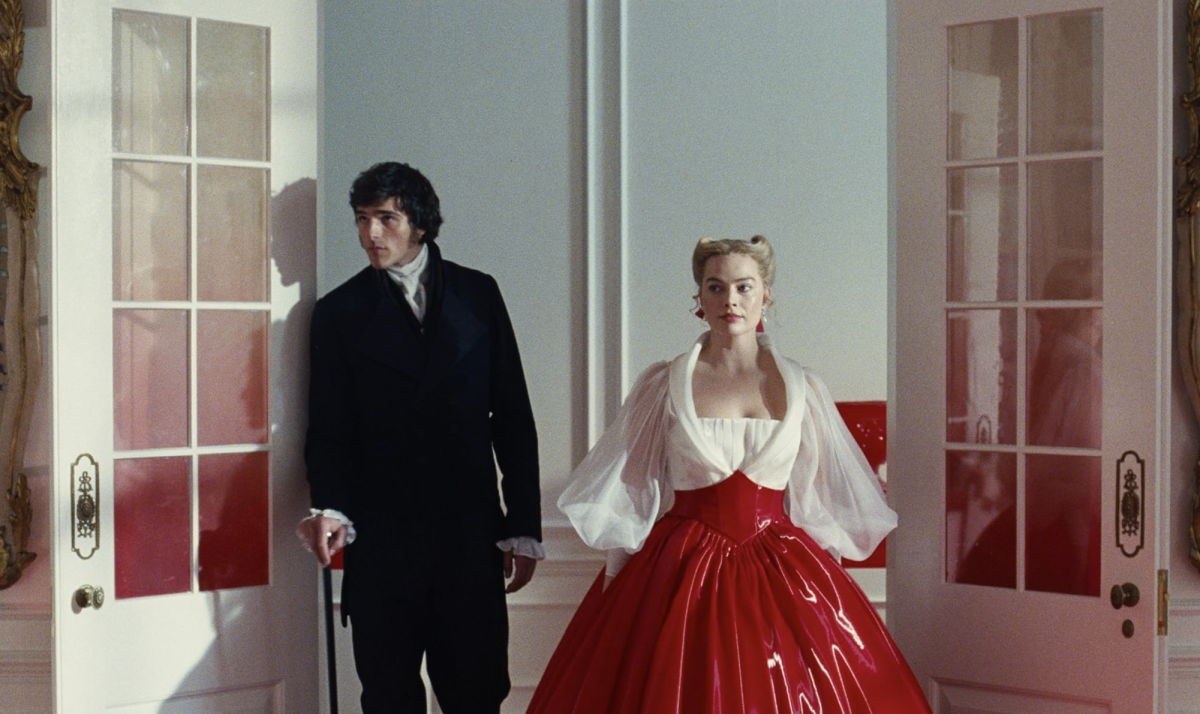
There are two ways to watch a literary adaptation: with the book in your back pocket or with absolutely no context at all.
I chose the latter. I walked into Emerald Fennell’s “Wuthering Heights” knowing nothing about the story or why generations of English teachers keep assigning it. Only after the credits rolled did I open Emily Brontë’s novel to see what the film had adapted and what it very clearly decided to reinvent.
I wanted to experience the film the way a completely new audience member would. Doing it in that order made the whole experience way more interesting. Because as a standalone movie, the movie is emotionally effective and visually absorbing. But once you start comparing it to the source material, you begin to see where the interpretation starts to drift.
First watch: The film on its own
Judging the movie purely on first impression, I understand why it pulls people in.
The atmosphere is the first thing that hits you. There’s something very eerie about the film itself. It slightly suffocates you in a way that makes you feel like you’ve been dropped into another time. I went in not even fully sure of the historical setting, and, strangely, that worked in the film’s favor. It feels immersive enough that you just accept the world and settle into it.
Emotionally, the movie definitely knows how to provoke a reaction. I found myself getting genuinely frustrated with certain characters (Nelly, respectfully, you stressed me out), which is usually my sign that a film is doing something right. When a story can raise your blood pressure a little, it means you’re invested. I saw it on Valentine’s Day at 10:30 p.m., small crowd, mostly couples, and there were definitely a lot of sniffles in the room. I’ll leave it at that.
As a pure viewing experience, I’d land at about a B-minus. It’s engaging and it knows how to pull feeling out of the audience. But it didn’t completely floor me either.
Then came the book …
Reading the novel afterward is where things start to shift.
One of the biggest differences is Heathcliff’s characterization. In Brontë’s book, he is repeatedly described in racially ambiguous terms (most notably as a “dark-skinned gypsy”), and that outsider status is tied to how other characters treat him and how his identity develops over time. The film, however, completely removes that layer. Without getting into spoilers, this change does a lot more than just alter surface-level representation. It completely reshapes some of the social tension that exists in the original story. Whether viewers feel that loss will probably depend on how closely they value fidelity to Brontë’s themes versus Fennell’s reinterpretation.
And that really becomes the central question of this adaptation: Is this meant to be Brontë’s “Wuthering Heights,” or Fennell’s personal reimagining of it? Because the film clearly leans toward the latter.
Adaptation vs. interpretation
To be fair, “Wuthering Heights” has always been a notoriously difficult novel to adapt. At least based on what I’ve heard. The tone is psychologically intense, and the emotional dynamics are … messy, to put it lightly.
Fennell seems less interested in strict literary translation and more interested in capturing the emotional fever dream of the story. In some places, that works. The film absolutely preserves the heightened emotional intensity that defines the novel’s reputation.
In other places, though, the simplification of certain character dynamics and background elements makes the story feel more straightforward than Brontë’s version arguably intends. That doesn’t mean this makes the film “bad.” It just makes it different.
Final verdict
Watching “Wuthering Heights” blind first was honestly the best decision I could have made. As a movie, it’s immersive and visually memorable enough to hold your attention from start to finish.
But after opening the book, it becomes pretty clear that this isn’t trying to be a page-for-page translation. It’s more of a stylized interpretation that captures the mood of doomed romance while smoothing out some of the novel’s more complicated edges.
If you go in expecting a faithful academic adaptation, you may find yourself raising an eyebrow.
If you go in ready for an emotionally driven reimagining, you’ll probably have a much better time. I’m still very glad I watched it the way I did. Sometimes that tells you more than any spoiler ever could.
Grade: B-